Santa Fe
The ClimbSanta Fe is the New Mexico refuge where Anatoli Boukreev arrives hoping to recover before returning to the Himalaya, but it becomes a place where the Everest disaster keeps breaking into ordinary life. Sleep, interviews, memorials, and the work of writing bring him back to the climbers he could not save; the city also becomes the setting for a sustained collaboration that carries his account toward publication.
Arrival and troubled rest
A friend had invited Boukreev to Santa Fe to rest and prepare for his fall return to the Himalaya. For the first several days he slept for much of the time, sometimes as long as twenty hours straight. The quantity of sleep did not bring relief: dreams continued from his journey between Bangkok and Los Angeles, in which he returned to the summit at the edge of his strength or was called to rescue stranded climbers he could not reach.
The dreams had different stories but a recurring predicament: people in trouble, barely within the limits of his ability to get to them. In Santa Fe the pattern became part of his waking routine. He would wake, eat breakfast, feel exhausted by the dreams, and go back to bed, only for them to begin again. He was always searching for people. The repetition gives the town’s promised privacy an unsettled quality: the mountain is distant, but the emergency returns in sleep.
The press finds him
That privacy proved temporary. On June 4, while Boukreev was having breakfast, Peter Wilkinson, a contributing editor for Men’s Journal, called to request an on-the-spot interview. Wilkinson began with pointed questions, and Boukreev, surprised by their rapid pace and struggling with the English needed to follow their complexities, covered the mouthpiece to ask for advice. He did not know the caller or his purpose. Even so, he continued because he wanted to help the journalist understand the story from his professional perspective; frustration eventually overcame his ability to sustain the interview.
Wilkinson then faxed his questions so Boukreev could answer when he felt he understood them. Boukreev’s attempt to retell the incident aggravated the dreams and made it difficult to sleep without the story in his head. On June 7 he flew from Albuquerque to Seattle and went directly to Jane Bromet’s house to continue the work. The following day, shortly before attending a public memorial for Scott Fischer, he faxed the answers he had managed to complete, though they remained incomplete. Santa Fe thus marks both his wish not to retreat into silence and the practical difficulty of making his account understood across language and press deadlines.
Memorials and memory of Fischer
At the public memorial, people had come from around the world to honor Fischer. His family and friends, despite their grief, were kind to Boukreev and thanked him for his efforts. He thanked them in return, but felt devastated and disconnected from the memorial. He believed he had done everything he could, yet had been unable to save Fischer or Yasuko Namba. He kept to himself, with little desire to meet or talk with the many friends present.
The next day’s private service, devoted to Fischer, was difficult in a different way. As Fischer’s parents and friends spoke intimately about his life and work, Boukreev struggled to sit still; he paced and looked at an exhibit of Fischer’s photographs. He remembered a relationship that included differences and misunderstandings, alongside deep respect for Fischer as a climber and as a man. He feared that in five years, or perhaps less, Fischer might be remembered only by family and close friends. What he hoped would endure instead was Fischer’s enthusiasm and energy among fellow climbers and clients, qualities that had drawn people to him. Boukreev considered him more romantic than businessman, and the memorial turned private grief toward the question of what a climber leaves behind.
Disputed accounts and the work of explanation
In late July, Boukreev received Jon Krakauer’s article. By coincidence, Martin Adams had arrived in Santa Fe that same day, and the two men listened as the article was read aloud around a large circular table on a patio. As Krakauer’s account described Boukreev as returning to Camp IV at 4:30 p.m. before the storm, without waiting for clients, and called the conduct questionable for a guide, Boukreev leaned forward to catch the meaning. He looked around the table, wondering whether the others had heard the words as he had.
Boukreev’s objection was that Fischer had authorized the descent as a plan to have support ready below, and that the plan had worked. His account of the discussion was that he expected to be more useful at Camp IV, where he could take oxygen to returning climbers or help anyone weakened on the descent; remaining immobile in the cold at that altitude, he reasoned, would cost him strength and leave him unable to assist. The disagreement was not merely over where he had gone, but over the meaning of that decision and whether the guide had abandoned clients.
The article also raised questions for Boukreev about how the competing accounts had been assembled. He wondered whether he had misunderstood Krakauer’s questions or Krakauer had misunderstood him. He had given Krakauer his answers to Wilkinson, and had also provided the same interview to the editorial department of Outside when discussing the possible use of his expedition photographs in the article. According to Boukreev, no one at the magazine checked with him about the conversation with Fischer above the Hillary Step or about what he had worn on summit day. On July 31, with friends’ help, he wrote to Mark Bryant, the editor of Outside. Santa Fe was therefore not just a site of recovery, but a base from which he tried to answer a public account he believed had misrepresented his decisions.
Writing, risk, and departure
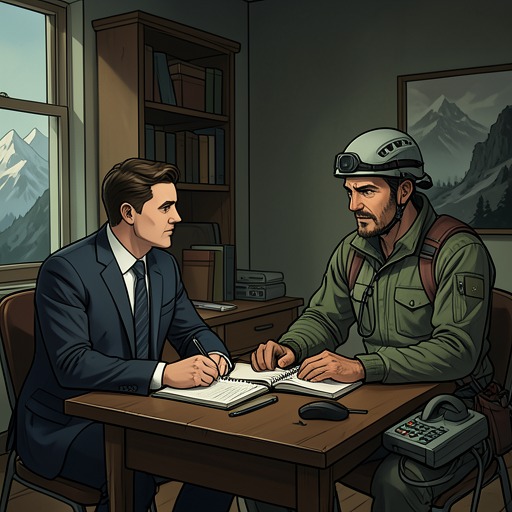
In the months after the tragedy, Boukreev and G. Weston DeWalt met almost every day in Santa Fe to discuss the book they planned to write. They often began early so Boukreev could spend afternoons training and running in the Sangre de Cristo Mountains of northern New Mexico. Their work took place amid small domestic details: at Boukreev’s kitchen table, a jar of Nepalese honey and a freshly baked loaf of bread stood between them while they drank dark Russian tea and waited for the bread to cool.
As Boukreev prepared to leave Santa Fe for attempts on Cho Oyu and Shisha Pangma, he and DeWalt divided the book-related tasks to be done during his absence. DeWalt read through his notes; Boukreev listened, then sat rigid and expressionless for several seconds before saying, “If I come back, you will have this. If I don’t, you must to do it.” The sentence turns their division of labor into an acknowledgment of the danger that remained part of Boukreev’s mountaineering life. Three times during the writing, he left Santa Fe for expeditions, and each time they agreed that DeWalt would finish anything left undone if Boukreev did not return.
The city’s role consequently extends beyond a pause between climbs. It is where Boukreev’s recurring rescue dreams, public explanations, grief for Fischer, and literary collaboration converge. The writing begun there would become The Climb, published in late October 1997; Boukreev and DeWalt then embarked on a demanding book tour arranged by St. Martin’s Press. Santa Fe could not end the disaster’s return, but it gave Boukreev and his collaborator a place to shape its account and carry the unfinished work forward.